I am organizing a Cache In – Trash Out Event (CITO) for the conservation land behind Ralph Wheelock School in Medfield. If this sounds complicated, fear not. It is a simple cleanup effort that uses the power of GPS devices and the community of geocachers to bring a group of people together at the same time and place. The event is scheduled for 9/26/2010 at 2pm. Bring the entire family, trash bags, a rake, and any other tool you may find helpful. 

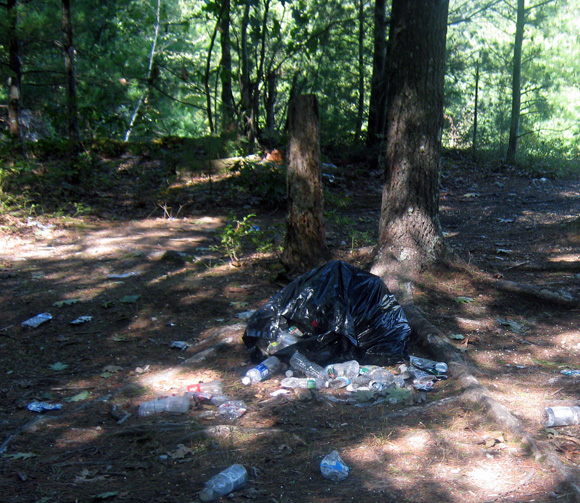
Specifically, I want to target the area behind the gravel pit, on top of the hill, that is the location of frequent parties and the site of camp fires and BB gun practices. Unfortunately, the people engaged in these activities do not show much appreciation for the land, and at the end of this summer there is an extensive mess that is too much for one casual dog walker like myself to clean up. I am counting on the support of like-minded Medfielders and geocachers. 

It is difficult not to get upset about this mess, which is entirely unnecessary

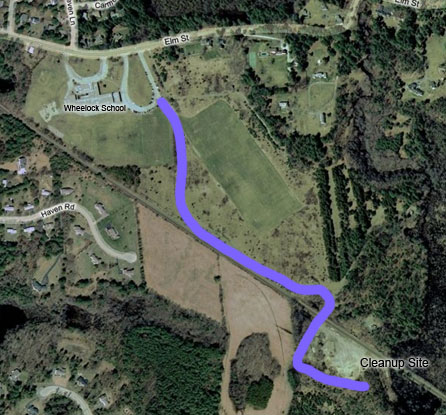
I created a CITO event on geocaching.org that can be used by geocachers to locate the site. It is also very close to an existing cache (A Stop along the Bay Circuit Trail).  Let’s meet at 2pm on Sunday 9/26 (the day after Medfield day) at the site. Parking is available at the Wheelock school, although during soccer games and practice, which is likely to be going on on a September Sunday, it may be necessary to park some distance away from the gate that is the entrance to the soccer fields, but also marks the beginning of the paved trail that leads to the site. 

A 10-15 minute walk from the Wheelock parking lot

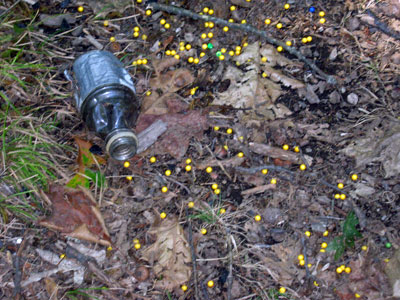
The trash consists primarily of bottles, cans, and BB gun artifacts such as CO2 cartridges and millions and millionss of plastic pellets that are strewn all over the area. I am not sure if it will make sense to try cleaning up the latter, since they are so small and there are so many. On the other hand, if left alone, they will soon be covered by leaves, so this is the last opportunity to collect them. I am thinking of using leaf blowers and shovels, but the resulting material will be a mix of soil, wood, and plastic pellets, it will be heavy, and there will be a lot of it – probably too much to be hauled away by volunteers on foot. Let me know if you have a better idea.

Plastic pellets cover the entire area

Dave Atkins of the Westwood Bike & Pedestrian Safety Committee reports an accident involving a 10 year old boy and an Audi convertible. This happened in front of a Hanlon School. Luckily the child only suffered broken bones. Follow the story on Facebook.

I have been wondering for the past 5 years what an odd/even water ban is. If you have, too, I have good news, because the PWD handed out flyers at the transfer station today that explain it. It means that you can water on odd or even days only, depending on your street number. Even street number = water on even days.

Unfortunately, my sprinkler system cannot be programmed to only water on even days. Westwood is doing this differently – you can water on certain days of the week. This would be too simple for Medfield, I suppose.

Anyways, the problem with my lawn is that it dies from the heat, not necessarily a lack of water, so there is no point in continuing to water in the summer. I cannot justify the amount of water that it would take to keep it alive – I’d have to have the sprinklers running 24/7. With only being allowed to water every other day, the difference will not be noticable. So I will probably just turn the sprinklers off entirely and enjoy the savings on my water bill. The grass will come back with the rains and the cooler weather in the fall – it always has.

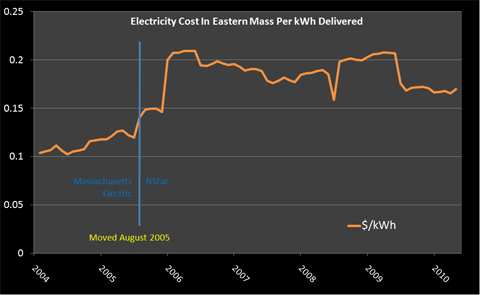
The price of electricity in Massachusetts doubled in 2005, then remained very high util late 2009. We saw a 25% decline in 2009, and since then the price is holding steady again. I switched from Mass Electric to NStar when we moved in 2005, but I doubt that this had any influence on the bigger picture.

6 Years of Electric Bills

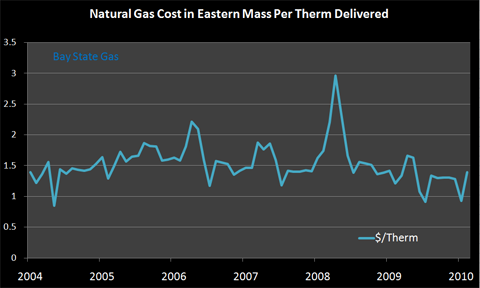
The price of natural gas is much more volatile due to seasonal demand, but it has come down recently to levels not seen since 2004. Good new for home owners – the trend seems to continue.

6 Years of Gas Bill

I discovered Cabot “Greek Style” yoghurt at Shaw’s today – 10% fat and sooooo good. The taste immediately brought back the memory of eating breakfast at 1 pm, when the little village you are in is void of any shade (and the temperature has already crept past the 100°F mark) while suffering from a serious Metaxa1 hangover… – and the subsequent feeling that one cup of 10% yoghurt is all the “solid” food you need for the day.

This totally makes up for the fact that our Shaw’s no longer carries Irish butter (the only thing in the store that tasted, smelled, and looked like actual butter). I am just going to have to substitute Greek yoghurt for the butter on my bagels now.

Even if you do not share my memories of eating Greek yoghurt in Greece, you may want to try it out. And please ask random employees at Shaw’s to bring back the Irish butter, or any other imported butter for that matter – the Danish butter (Lurpak) is even better.

1Greek brandy

Arlington parents wrestle with idea of kids biking to school – The Boston Globe

Posted using ShareThis

Last November, the board of selectmen decided to move forward with the appointment of three new members to the Safety Committee, which is now 5 members strong. The intent was to expand the scope of the work and put a larger focus on pedestrian and bike traffic. The organizational meeting of the group was held in February, and the committee will meet monthly. The public is invited to attend.

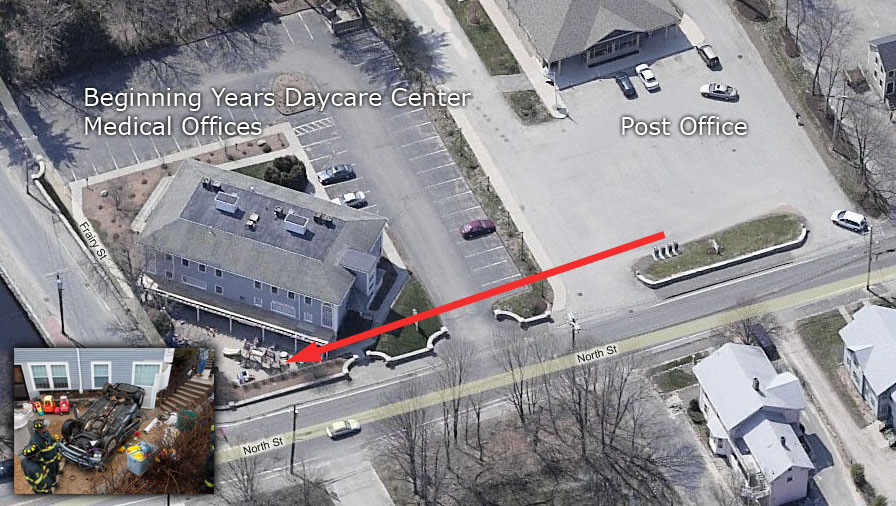
Recent traffic accidents on North Street prompted an article in the Hometown Weekly. Based on quotes mentioned in the article, it appears that residents and the police chief are advocating measures that will make speeding safer on North Street. The prevailing opinion is that the road is the problem, not the people driving on it. I find this interesting. I know the location quite well. There is a 30mph speed limit, and most people drive faster there, many significantly faster, and some too fast. Because it is not safe to go faster than 30mph in this curve shown on the picture, even in good weather, we are going to spend money on redesigning the road, so that speeding is safe again. 

It seems that Medfield officials believe that the majority of the Medfield electorate are  members of a secret club – the notorious “I insist on my right to drive 50mph in a 30mph zone and I will vote you out of office if you take this right away” club. I have no other explanation for the reluctance among town officials to do anything that could upset drivers.

Interestingly enough, every other driver I talk to about this issue, neighbors and other parents, is as upset as I am about the relative lawlessness on Medfield streets. Is there possibly a disconnect?

I believe that most people who speed in town, like the Wheelock elementary teacher who races down South Street in a Jeep Cherokee every morning after getting coffee at Lord’s, do it out of habit, not because they want to do something illegal and dangerous. Over time, habits create a sense of entitlement. This is the real danger, and it is not confined to North Street or any other singular spot.

Dover  installed speed bumps on Centre Street last year. They are safe and very effective. If we want to reduce the number of accidents, and especially the number of fatalities, we should be looking into how to slow traffic down, as opposed to how to speed it up. Simply by forcing people to break with their habits. Speed bumps are one way of doing that. Fines are another.

The analysis chart for 2009 shows 2 sets of data over time. The top graph represents the maximum, minimum, and the mean speed per day. The bottom graph shows the number of cars counted per day, plus a 30-day moving average to highlight trends.

Click to view a larger version

Click to view a larger version

The deep snow cover in February blocked the radar device’s the clear view to the street, which caused much lower numbers for several weeks. Only larger cars and trucks would register.

With only one year’s worth of data, there is not too much that can be interpreted into this chart. Aside from isolated events such as snow storms, road construction, holidays etc. that have an impact on traffic patterns, the seasonal variations in traffic make a long-term prognosis impossible. It is interesting to see how little an impact the chip-and-tar application had last August on both traffic volume and speed patterns, though. Or that back-to-school day is busiest day of the year, traffic-wise, with a clear margin.

It appears that both overall volume and speeding offenses are on the increase, but in order to extract a trend, at least 5 years of data will be needed. Once the homes on Eric Road are occupied, there will certainly be an impact on the traffic volume on Green Street that should be apparent on next year’s data. Once there are multiple years of data, I will publish a year-to-year comparison by month, to eliminate seasonal variations.

http://www.openstreetmap.org seems to be a site similar to Google maps, but without the satellite imagery, Google Street View, and the ability to calculate driving directions. So why bother using it?

For starters, the maps are in the public domain and can be used freely for almost anything, unlike Google’s maps. They get created and continuously improved by the community and are in many cases more up-to-date and accurate than Google’s maps.

I added the location of the proposed Bay Colony Rail Trail corridor some time ago, which was fun to do, but my effort pales in comparison to what Dave Lafreniere of the Friends of Medfield Forests and Trails did. He added the Charles River and other water bodies, and he GPS-traced and mapped every few feet of trail in our town, including Rocky Woods and Noon Hill reservations. This must make Medfield one of the best-mapped communities in the country. Check it out, it is an amazing asset for the town.

Trails behind Wheelock school on OpenStreetMap.org

Trails behind Wheelock school on OpenStreetMap.org

It was one year ago on November 23, 2008 at 5:44pm when the Green Street speed radar went into operation, and since then it has been dutifully recording every vehicle travelling by, almost 270,000 of them. (more…)

As a new dog owner since last week (we rescued a yellow lab mix puppy), a recent fatal dog bite incident in Austria caught my attention. The incident involved a Rottweiler and a 1-year old child. Apparently the dog saw a threat in the child when the father returned from work and the family rushed to greet him. (more…)

I love to run, even in the winter. I wish I had the time to be out more often. One of the worst things that can happen on a clear and crisp winter morning is having to run by a car that is idling in someone’s driveway. A sharp pain enters my lungs from the exhaust fumes, and I try to breathe as flatly as I can until I am far away.

Why do people install remote starters so that they can start their cars and let them sit in their driveways for 30 minutes or more?

Here is what Consumerreports.com has to say about this practice:

Myth: Let your engine warm up for several minutes before driving.

Reality: That might have been good advice for yesteryear’s cars but is less so today. Modern engines warm up more quickly when they’re driven. And the sooner they warm up, the sooner they reach maximum efficiency and deliver the best fuel economy and performance. But don’t rev the engine high over the first few miles while it’s warming up.

Clearly, this makes sense. But they forgot to finish this thought – if it is better to drive your engine to bring it up to operating temperature, it is worse to not do it. So people who start their car with a remote starter and then let it idle, actually reduce the life expectancy of the car. Think about it this way: The most wear and tear for any engine happens right after it gets started, and the lubricant (oil) is cold and has not reached the proper viscosity that is needed to do its job. The longer the engine runs cold, the more wear it will get. So, start the engine and drive away!

check -  Idling cars in driveways – bad for the cars

European governments have made this practice illegal in the 70s, not because they wanted to help people with extending the life of their cars, but because it is so bad for the environment. Not only do engines do a poor job lubricating themselves when they are cold, they also do a very poor job burning gasoline. The gas does not burn completely, and at no other time does an engine blow more residual substances into the atmosphere than when it is cold.

check -  Idling cars in driveways – bad for the environment

Poisonous exhaust fumes from a neighbor’s driveway can enter garages and homes where children live who then develop asthma or other horrible conditions as a result.

check -  Idling cars in driveways – bad for the health of the neighbors, and bad for neighborly relationships

And finally, if you own a vehicle with a remote starter and actually use this feature to start it up before you step into the shower in the morning, watch out. You might get whacked over the head with a snow shovel by your neighbor who’s kids now have asthma.

check -  Idling cars in driveways – bad for the owner

Will you start your car to let it idle in your driveway this winter?

In addition to Rt 27, you can now take a virtual drive along Rt 109, South, North, and Pine Street.
(more…)

Below is the information for my internet safety class. Click here to download the slide deck in PDF format.

Location—High School Room 119
Date—Thursday, October 15th, 2009
Time—7:00—9:00pm

Children and the Internet – a combination that creates fear, resignation, and ultimately denial among parents. Whether you are worried about exting, your kids seeing inappropriate content, spending too much time surfing the web, or introducing Spyware and Trojans into your home network – fear no more. In this class you will learn how to take a proactive approach to managing web access for your children. Technology cannot replace good parenting, but there are hardware and software tools that can help you restrict and monitor how the kids spend their time online. You will learn the needs and risk profiles of specific age groups, and develop a technology strategy that will help keep your family and your computers safe from Kindergarten through Grade 12.

Next Page »